exercise · Sep 19, 2026
The Three-Shape Exercise
A circle, a square and a triangle on a single sheet, ninety minutes, three colours. The brief I set every year, the rules, and the five ways it usually goes wrong.
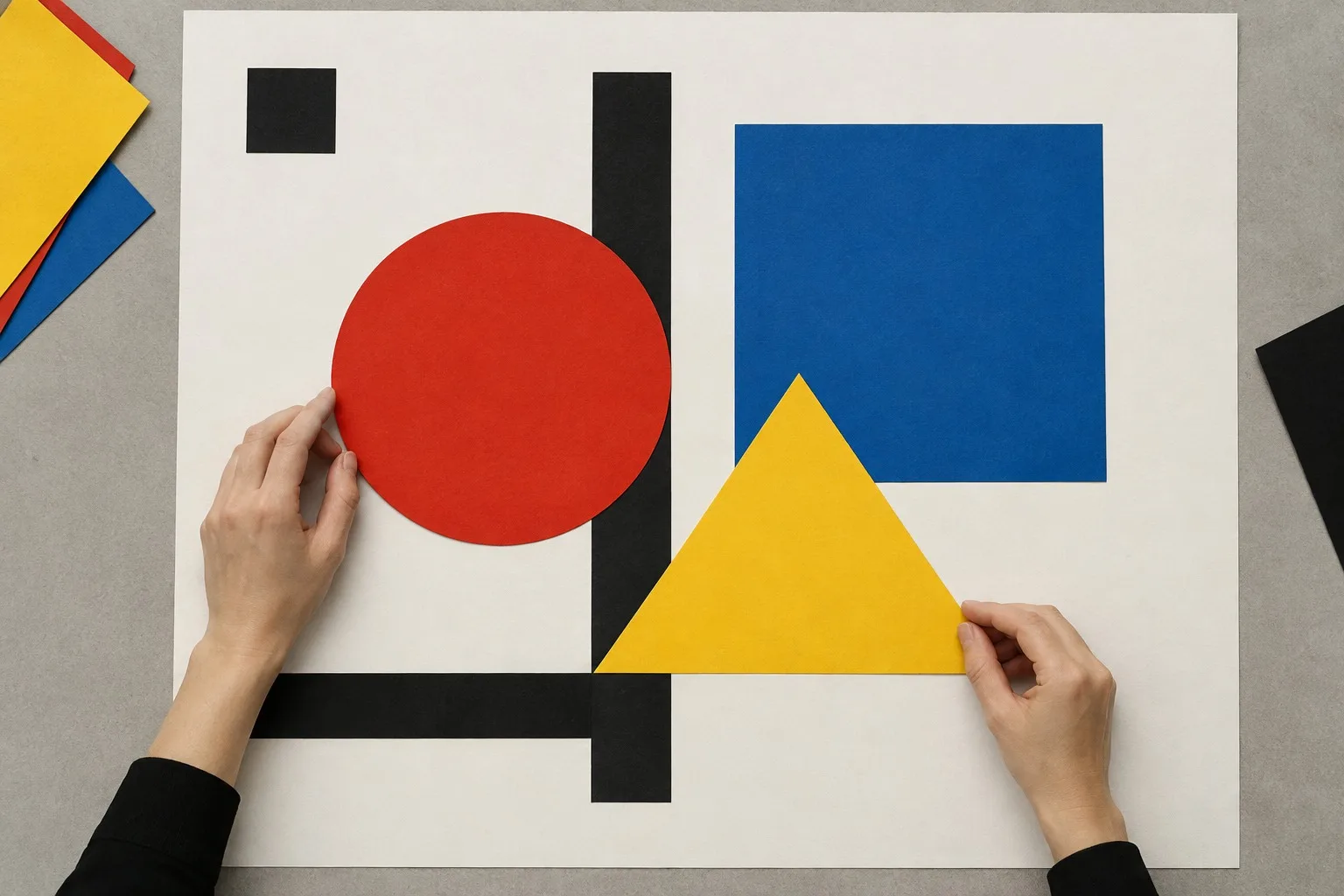
The brief fits on an index card. I read it aloud on the first Monday and then refuse to explain it.
One sheet. One circle, one square, one triangle. Three colours, chosen from the five we have studied. Ninety minutes. At the end the sheet must say something, and I do not mean words.
The rules
Rules are what makes it a lesson and not a doodle.
Each shape appears once. No copies, no halves, no hidden repeats.
Shapes may overlap, touch, or stand apart, but they must relate to the grid you drew on the first day.
Every colour is used at least once, and no colour is used on more than one shape.
No gradients, no outlines, no shadows. Cut paper or flat ink.
The sheet has a title, but the title is not on it. I will ask each student to name the sheet aloud.
Five rules is already one more than a hand holds comfortably. Keep the list short enough to hold.
What I am watching for
I walk the room and say very little. Mostly I look for tension. A good composition has a pull in it, a sense that something is about to move. The circle is almost rolling off. The triangle points at the square like an accusation. The square is not impressed.
A poor composition has all three shapes lined up like guests at a wedding, centred and polite, each waiting to be introduced.
Five ways it goes wrong
Everything is centred. The sheet feels safe and dead. Slide something to the edge.
All three shapes are the same size. There is no hierarchy, so the eye has nowhere to begin. Choose a hero.
The colours were picked by taste, not by weight. Put the heaviest colour where you want the weight.
The shapes do not touch anything. They float. Let one shape overlap another and watch the sheet organise.
The student explains it too much. If the sheet needs a speech, it is not finished.
The critique
At the end of the ninety minutes we pin everything to one long wall. I ask each student to stand beside their sheet and name it in one line, then stay silent while the others speak.
This is the hardest part and the best one. Hearing a stranger describe your sheet as "a quarrel" or "a seesaw" or "a small town at night" teaches you what the composition actually communicates, which is rarely what you meant. Take notes. Fix the next one.
By the autumn term every sheet is better, and nobody can explain how. The explanation is a few hundred rolls of tape and a refusal to add a fourth shape. The next piece puts the whole method to work on something with a deadline: a poster, annotated.
No comments yet
Comments are open. Have a thought or a question? Share it below.